
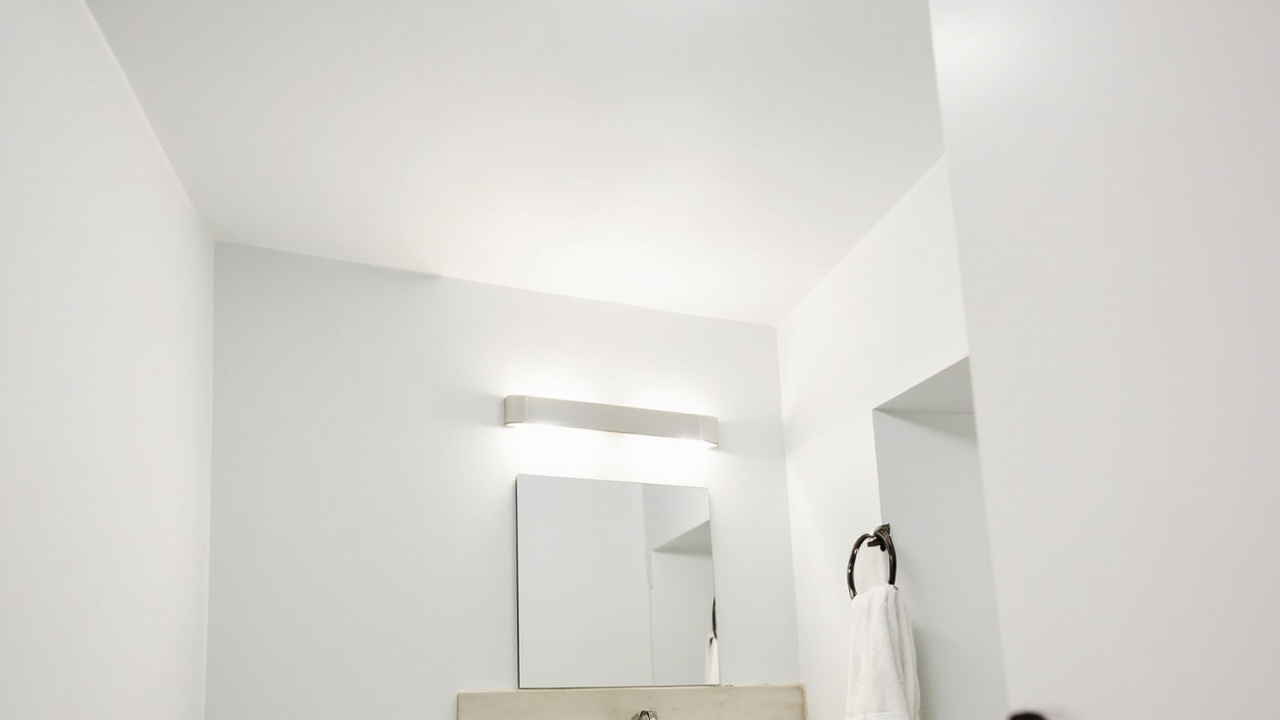
Not every bathroom project needs to be a full remodel. On this project in Brookline, the scope was repair, not renovation: cracks and water stains on the ceiling were repaired, mold was removed, and the ceiling was repainted. Holes in the walls were patched. The vanity was replaced, with an iron P-trap replacing the PVC one for a better look. A smaller mirror went up centered over the vanity, and the light fixture was replaced and centered to match. The grout near the door threshold was repaired, and towel holders went in — a new holder above the toilet replacing the old one, and a hook above the radiator.
Seven items. No gut, no new layout, no walls opened. Here is what the work actually involved — and how to tell when a targeted repair is the right call.
What the Project Included
- Repair of ceiling cracks and water stains, mold removal, and repainting of the ceiling
- Patching of holes in the walls
- Replacement of the vanity, with an iron P-trap replacing the PVC one
- A smaller mirror, installed centered over the vanity
- Replacement of the light fixture, centered to match
- Repair of grout near the door threshold
- Towel holders: a new holder above the toilet replacing the old one, and a hook above the radiator
The Work, Step by Step
1. The ceiling: cracks, water stains, mold, repaint
The ceiling had visible cracks and water stains — the kind of damage that draws the eye the moment you walk in. The repair meant filling and smoothing the cracks, treating the stained areas, removing the mold, and then repainting the whole ceiling so the repair blended in instead of standing out as a patch.
Ceiling work is one of those jobs where the finish matters as much as the repair. A ceiling that is patched but not properly repainted still looks damaged. The repaint is what makes the repair disappear.
2. The walls: patched, not replaced
Holes in the bathroom walls were patched and finished to match the surrounding surface. Wall patching is straightforward work, but it has to be done carefully — a patch that sits proud of the wall or shows a visible edge will catch light and look worse than the hole did. The goal is a wall that reads as one continuous surface.
3. The vanity: replaced, with an iron P-trap
The old vanity came out and a new one went in. With it, the drain got an iron P-trap instead of the PVC one — chosen for how it looks under the new vanity.
4. Mirror and light, replaced and centered
The new mirror is smaller than the old one, and it was installed centered over the vanity. The light fixture was replaced too — the old one came out and a new one went in, centered to match the mirror. These are small alignment details, but they change how the whole room reads — a mirror and light that sit off-center make even a new vanity look like a compromise.
5. Threshold grout and towel holders: the finishing details
The grout in a small area near the door threshold was repaired. It is a small patch of work with an outsized effect on how finished the bathroom feels — worn grout at the threshold catches the eye every time you walk in.
Towel holders rounded out the project: the old holder above the toilet was replaced with a new one, and a hook went up above the radiator. They are the kind of items that never drive a project on their own, but a bathroom without a proper place for towels is a bathroom that is not quite done.
When a Targeted Repair Is Enough
This is the question behind every repair project: fix what is broken, or start over? On this project, the answer was a targeted repair — seven items, each one a fix to something specific: the ceiling, the walls, the vanity and its drain, the mirror and light, the threshold grout, and the towel holders.
A full remodel is a different project for a different scope. The honest way to tell the difference is to look at what is actually there — which is why we start with an on-site visit before recommending anything.
Thinking About Your Bathroom?
If your bathroom has a cracked or stained ceiling, worn fixtures, or details that were never quite right, the first step is a look at what is actually there. We do free on-site estimates: we look at the bathroom, talk through whether repair or remodel is the right scope, and put the scope in writing.
No pressure, no sales pitch — just a clear picture of the work. (We’re licensed and insured, proof available on request.) Request a free estimate and we’ll schedule a visit.